NASDAQ (NDAQ)·Q4 2025 Earnings Summary
Nasdaq Beats on EPS and Revenue as Index Business Surges 23%
January 29, 2026 · by Fintool AI Agent
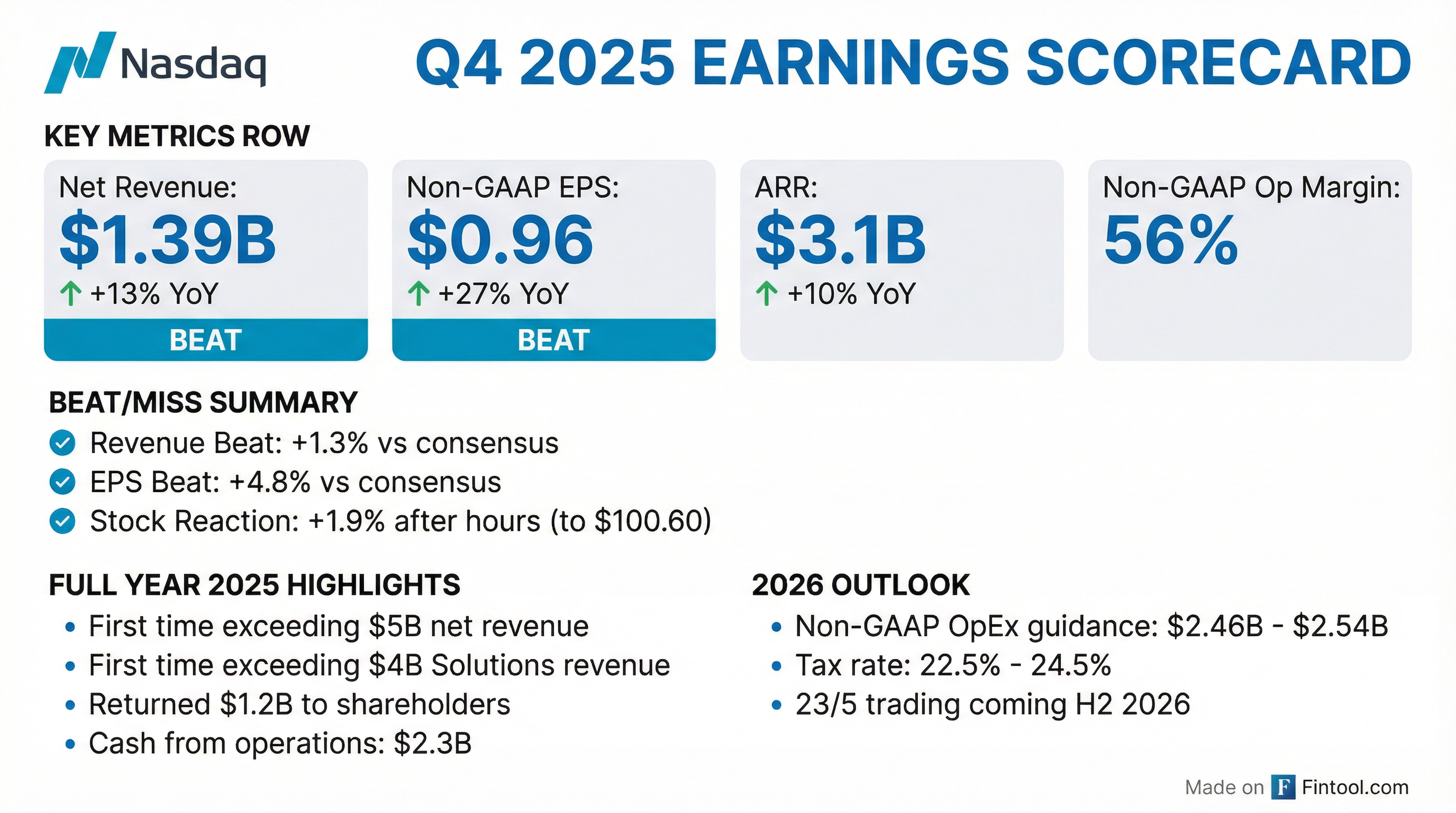
Nasdaq delivered a clean beat across the board in Q4 2025, capping a milestone year that saw the company exceed $5 billion in annual net revenue for the first time. Non-GAAP EPS of $0.96 beat consensus by 4.8%, while net revenue of $1.39 billion topped expectations by 1.3%. The stock rose 1.1% in after-hours trading to $99.80.
The quarter was headlined by exceptional strength in the Index business (+23% YoY) and Financial Technology (+12% organic), while the "One Nasdaq" cross-sell strategy continued to gain traction with 42 total cross-sells since the Adenza acquisition. Nasdaq also formed a new partnership with BioCatch to enhance financial crime detection capabilities.
Did Nasdaq Beat Earnings?
Yes. Nasdaq beat on both revenue and EPS for the eighth consecutive quarter.
Full Year 2025 Performance:
 Ask Fintool AI Agent
What Drove the Quarter?
Index Business: The Star Performer
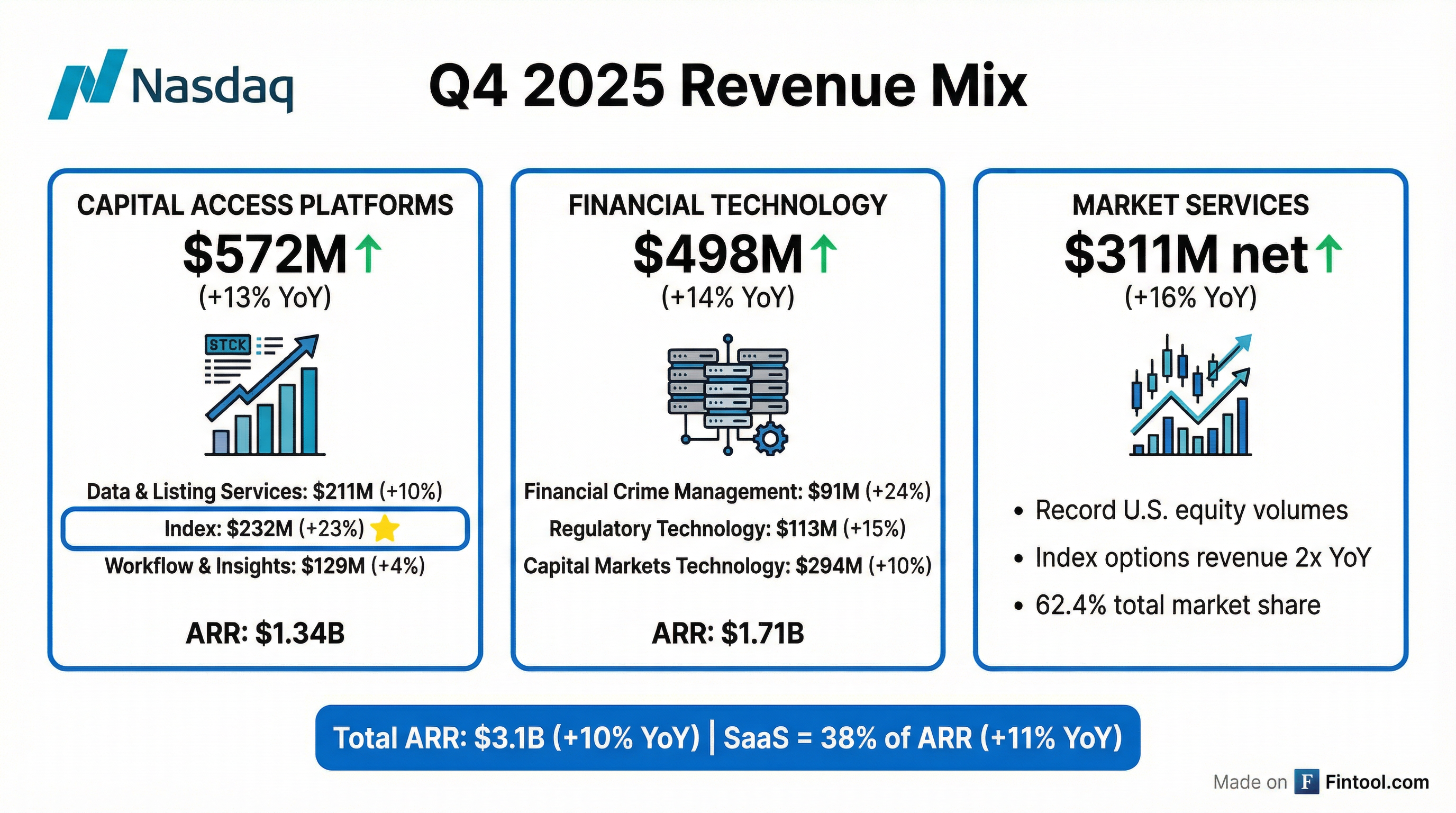
Index revenue surged 23% YoY to $232 million, driven by:
- Record ETP AUM: $882 billion (end of period), up from $647 billion YoY
- Record net inflows: $99 billion over trailing 12 months, $35 billion in Q4 alone
- New product launches: 122 in 2025 (all-time high), including 60 international and 32 institutional insurance/annuity products
Listings highlights:
- 72% win rate under new methodology (accounts for IPOs, direct listings, SPAC combinations)
- $1.2 trillion in listing transfers (record year for switch program)
- Walmart transfer completed — largest exchange switch ever
- 7th consecutive year as leading U.S. exchange by proceeds raised
Financial Technology: Strong Execution
Financial Technology revenue grew 12% YoY to $498 million, with all G-SIBs now Nasdaq clients:
Key wins in Q4:
- 129 new clients, 143 upsells, 12 cross-sells
- Verafin signed 119 new small/medium bank clients + 3 Enterprise deals
- Enterprise signings in 2025 were 4x prior year in both count and ACV
- Calypso now serves 24 central banks (3 signed in Q4)
- CFTC selected Nasdaq to replace its legacy surveillance system
- 26 new surveillance clients across exchanges, crypto venues, and regulators
- Net revenue retention of 112% in Financial Crime Management
Market Services: Record Volumes
Market Services net revenue grew 16% YoY to $311 million, benefiting from:
- Record U.S. cash equity and equity derivatives volumes
- Index options revenue more than doubled for the second consecutive quarter
- 62.4% total market share in U.S.-listed securities
- Closing Cross hit record $233 billion notional value (December Triple-Witch)
What Did Management Guide?
2026 Expense Guidance:
- Non-GAAP operating expenses: $2.455B - $2.535B (7% organic growth at midpoint)
- Non-GAAP tax rate: 22.5% - 24.5%
Q1 2026 Sequential Headwinds:
- Derivatives rate reset: Index derivatives contract rate resets at start of year; similar sequential revenue impact as Q1 2025 until revenue threshold crossed (likely early Q2)
- Listings headwind: ~$9M per quarter from prior year delistings, new listing standards, and initial fee amortization roll-off
Strategic Initiatives for 2026:
-
23/5 Trading: Nasdaq plans to bring extended trading hours to the Nasdaq Stock Market in H2 2026
-
Tokenized Securities: Filed with SEC to facilitate trading of tokenized securities on its markets
-
Agentic AI Workforce: Verafin's AI worker suite continues to expand:
- Agentic Sanctions Analyst (launched Q3 2025) — strong early client adoption
- Agentic Enhanced Due Diligence Analyst (launched January 2026) — newest worker
- Additional agentic workers planned for 2026
Ask Fintool AI AgentWhat Changed From Last Quarter?
Notable sequential improvements:
- Solutions revenue accelerated from +11% to +13% organic growth
- Financial Technology ARR growth improved from 12% to 14%
- SaaS as % of ARR increased from 37% to 38%
How Did the Stock React?
NDAQ closed regular trading at $98.71 (+0.21%) and rose to $99.80 in after-hours trading, up 1.1% on the results.
Key context:
- Stock is up 52% from its 52-week low of $64.84
- Trading just below 52-week high of $101.79
- P/E multiple expanded as earnings growth accelerated
Key Management Quotes
Adena Friedman, Chair and CEO:
"It was an excellent year of execution for Nasdaq, as we achieved strong organic growth, accelerated innovation, and successfully delivered across our three strategic priorities: Integrate, Innovate, and Accelerate. For the first time, Nasdaq exceeded $5 billion in annual net revenue and $4 billion in annual Solutions revenue, reflecting the power, resilience and adaptability of our platform."
Sarah Youngwood, EVP and CFO:
"In 2025, Nasdaq delivered outstanding financial results, underscoring the durability and differentiation of our business model. We delivered strong growth across our platform, expanded operating leverage, and generated robust cash flow."
Capital Allocation
Q4 2025:
- Dividends: $153 million returned to shareholders
- Buybacks: $286 million in share repurchases
- Debt paydown: $100 million of senior unsecured notes repaid
Full Year 2025:
- Total shareholder returns: $1.22 billion ($601M dividends + $616M buybacks)
- Debt reduction: $826 million repaid
- Remaining buyback authorization: $1.1 billion
Dividend declared: $0.27 per share, payable March 30, 2026
Efficiency Program Update
Nasdaq exceeded its expanded efficiency program target, achieving over $160 million in expense efficiencies actioned by year-end 2025.
The program, initiated after the Adenza acquisition, was completed as of December 31, 2025, though some costs may be recognized in H1 2026.
Forward Catalysts
-
Investor Day (February 25, 2026): Management to present strategy and operations update
-
23/5 Trading Launch (H2 2026): Could capture additional market share as trading hours extend
-
Tokenized Securities: SEC approval could position Nasdaq as first-mover in digital asset infrastructure
-
Index AUM momentum: With $99B in net inflows, continued ETF growth could drive further fee revenue
-
Cross-sell pipeline: 42 cross-sells since Adenza acquisition suggests runway remains
Ask Fintool AI AgentQ&A Highlights
The earnings call featured extensive analyst questions covering Nasdaq's key strategic initiatives:
Expanded Options Expirations (0DTE)
Patrick Moley (Piper Sandler) asked about the recently approved Monday/Wednesday/Friday expirations for Mag 7 names. CEO Adena Friedman noted:
"We're really pleased that we were able to launch this... The world is changing very quickly. Giving our clients more opportunity to manage risk in a shorter-dated way allows them to address changes in the marketplace in a much more precise way."
The feature has been live for only one week, with early uptick already visible. Management is focused on stocks with strong liquidity characteristics before expanding further.
Structural Shift in Options Volumes
Jeff Schmitt (William Blair) asked about sustained equity options growth despite lower volatility. Friedman cited a structural shift driven by:
- Broadening investor base (retail in equities, retail + institutional in options)
- Growth in ETF options overlay strategies driving institutional engagement
- More AUM flowing into ETFs with options overlay features
IPO Pipeline and Listings Outlook
Michael Cho (JP Morgan) inquired about the listings pipeline. Key points:
- Government shutdown delayed some Q4 issuers to Q1-Q2 2026
- Active dialogue with late-stage private companies seeking public market access
- Asset managers at Davos expressed premium value on liquidity given dynamic environment
- Introducing 72% win rate under new methodology that accounts for IPOs, direct listings, and SPAC combinations
Financial Crime Management Outlook
Dan Fannon (Jefferies) asked about the 24% growth trajectory. Management highlighted:
- Enterprise ACV was back-weighted in 2025 (H2 concentrated)
- Implementation takes time; ARR recognized only when clients are live
- Professional services revenue will see quarterly variability with implementations
- 9 enterprise deals in 2025 including 3 upsells (new modular capability)
ATS and Off-Exchange Trading
Eli Abboud (Bank of America) asked about SEC/CFTC rules limiting Nasdaq's ATS ownership. Friedman responded:
"The exchange rules are very codified, and it makes it very difficult to be an innovator within the confines of the exchange rules... We believe the SEC is going to provide a more flexible framework."
Capital Allocation Post-Deleveraging
Simon Clinch (Rothschild) asked about capital deployment now that leverage targets are met. CFO Sarah Youngwood outlined priorities:
- Organic growth investment
- Progressive dividend
- Share repurchases
- Debt repurchases
- Evaluate bolt-on acquisitions (build vs. buy approach)
Prediction Markets
Ashish Sabadra (RBC) asked about Nasdaq's interest in prediction markets. Friedman emphasized:
- Prefer to operate in regulated markets with clear rules
- Regulatory environment for prediction markets is "not really settled"
- Evaluating event options within regulated options business
- Currently provides technology and data distribution to prediction markets
Tokenization Strategy Deep Dive
Multiple analysts asked about tokenized equities. Key insights from Michael Cyprys (Morgan Stanley), Owen Lau (Oppenheimer), and Benjamin Budish (Barclays):
Core principles of Nasdaq's approach:
- Integrate with existing infrastructure (DTCC, transfer agents)
- Focus on investor protection, issuer choice, fungibility
- Maintain transparency and liquidity aggregation
- Allow investors to choose tokenized or traditional settlement
On liquidity fragmentation concerns:
"We have a mandate to bring liquidity together... We care about making sure investors have a complete view of trading of any equity, whether in tokenized form or not."
On blockchain-native trading:
"To have blockchain native trading of equities at the scale we have... the technology is not there. We manage 80-100 billion messages daily with latency of less than 20 microseconds."
5-year outlook:
- Tokenization could enable more efficient collateral movement across clearing houses
- 23/5 trading may increase addressable market globally
- Opens opportunity for expanded fintech services (surveillance, regulatory reporting)
Proxy Reform
Alex Kramm (UBS) asked about Nasdaq's proxy engagement. Friedman clarified it's about policy reform, not business opportunity:
"Our engagement on proxy has primarily been with regulators and established providers... making it so companies can spend their time operating their businesses and not dealing with proxy."
Ask Fintool AI AgentKey Risks & Concerns
- Market sensitivity: Trading volumes and Index AUM are market-dependent
- Competition: NYSE, CBOE, and alternative venues continue to compete for listings and trading share
- Regulatory: SEC approval required for tokenized securities and extended trading hours
- Integration: Continued execution needed on Adenza integration and cross-sell targets
- Q1 2026 headwinds: Approximately $9 million quarterly revenue headwind from delistings, listing standards changes, and initial fee amortization roll-off
Related Links: